Monday, November 2, 2009

Social Engagement, Private Creation

How does art that takes human relations and social context as its modus operandi translate to independent and private space, where all audience but one (the artist) is absented – the object and subject of long meditation rather than momentary experience? And visa versa, engagement of the world by a piece created in very private space out of very private thoughts? Is translation possible?

The first is theoretically judged on the inter-relations (conceptual and emotional) represented, produced, prompted, communicated, provoked, and perhaps -- at its deepest either unerringly harmonious, a echo precisely and unflinchingly in tune, or critically divisive, even shunned, not merely thought or shock inducing, the envelope precisely and aggressively pushed. It aims at the external, social relations being by definition external to any one individual, and if it fails to provoke conversation, it would seem it fails.

Judgment of the second on relational terms is less direct as it may not purport to care one wit about social constructs, and dialogue beyond the artist’s dialogue with himself or herself may not be within its creative considerations. It aims at the internal, the individual by definition being only one part of social relations. It is not necessarily Utopian, and indeed may positively or darkly reflect unacknowledged social constructs that have become a part of a person. If it enters into no dialogue beyond its private beginnings, it is the tree falling in the forest with no one there to see it fall. We may still go to the forest the next day and discover the felled tree and make assumptions about how it must have fallen – a construct. Or not.
Thinking Through Stages


Stage 1 is drawn entirely digitally. It's a reminder, though, that more time is needed working with colored paper, as there's not a sufficient light complex in the organization of the image here. Stage 2 below is an attempt to accentuate a light complex, with the turquoise serving as midrange; the image as a whole, however, is less successful than in Stage 1.

Added digital capture to Stage 3, below, providing a soft graininess. Stage 3 not a full assimilation. The arc adds dimension and activates the image as a whole; however, now there is not a dark complex.
The image was darkened in Stage 4, below, to recover some darks, and a color substitution followed in Stage 5, helping to tie the image together as a whole and creating a more cartoonish appearance.


This last two are another Stage 3, with a different digital capture added to Stage 2, creating two, rather than one arc, and Stage 1 with a different digital capture.


Source and meaning?

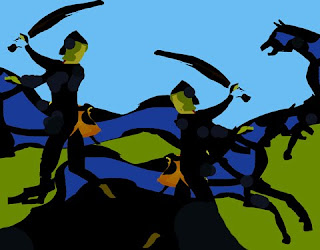
How much does the origin of an image -- it's original identity -- matter to meaning of the work incorporating it -- its new context and assimilated identity? Embedded above is a horse from Navajo rock painting depicting a massacre, though in this incarnation, there is nothing that earmarks or acknowledges the origin. The horse shape itself is barely visible. Even more invisible is a stylized dragon from the Bayeux Tapestry -- or lion/griffin, as it was hard to tell the animal's identity in the source image I found and I could not recall the real thing from seeing it years back -- reflected in a dotted outline and looking more snake than beast. Both source images reflect exterior contexts and battles/contests, and I've set them in the interior.

Friday, October 30, 2009

Thursday, October 29, 2009

PicADay: Digital Play From Inside Outside


There is lots of room for quick and sequential play with digital tools. I am playing with the space between abstraction and representation -- pushing representation into abstraction and pushing the abstraction back to representation.

Wednesday, October 28, 2009

Tuesday, October 27, 2009